


 Germany - Deutsch
 France - Français
 Italy - Italiano
 Spain - Español
 Turkey - Türkçe
 India - English
 South Korea - 한국인
 China - 中文
 Vietnam - Tiếng Việt
This article was first published in the EWI Issue-3 2026 of Elevator World India Magazine
Vertical Transportation (VT) systems—such as elevators, escalators, and travelators—are essential to modern infrastructure, enabling efficient movement of people and goods across buildings of all sizes. From residential complexes to high-rise commercial towers, their performance directly impacts user experience, safety, and operational efficiency. Selecting the right components, along with careful evaluation of key parameters and prerequisites, is crucial for optimal system performance.
At Inovance Technology, our VT solutions are built on seamless integration, high reliability, and intelligent control. This article outlines the key selection parameters and prerequisites and showcases how our NICE series integrated controllers and elevator drives—including NICE3000+, NICE1000+, and ME320L—deliver efficient and safe performance for modern buildings.

Mr. Subramania Bharathiyar, Elevator Product Head, Inovance Technology India
Understanding VT Systems
Vertical Transportation (VT) is a high-performance ecosystem of interconnected subsystems in which real-time synchronisation between power electronics and mechanical components is critical. Rather than operating as a collection of standalone parts, a modern VT system functions as a unified platform designed to deliver safety, precision, and passenger comfort. It is an integrated system that enables the movement of people and goods between floors in a building, incorporating elevators (lifts), escalators, and moving walkways working together in a coordinated manner.
A VT system consists of several key subsystems:
• Drive & motor system – provides controlled movement
• Controller – acts as the central brain, managing calls and operations
• Car & landing panels – serve as the user interface for floor selection
• Door system – ensures smooth and safe entry and exit
• Safety systems – protect passengers through brakes, sensors, and interlocks
The system operates by receiving user inputs, processing them through the controller, and executing precise movements to ensure efficient, safe, and comfortable transportation.
Understanding VT systems involves:
• Analysing user traffic patterns within the building
• Evaluating system response to varying passenger demand
• Measuring performance based on capacity, rated speed, and average waiting time
Vertical Transportation is not just about lifts—it is an intelligently designed movement system that integrates engineering, safety, and user experience to ensure efficient building circulation. Inovance offers a comprehensive Integrated E-Package—a full-stack VT solution engineered in compliance with IS 17900 and EN 81-20/50 standards.
Key VT Selection Parameters
1. Building Type & Application
The building’s occupancy type and traffic profile are the primary drivers in defining the optimal Vertical Transportation (VT) configuration. Systems must be designed to meet key performance benchmarks such as Handling Capacity and Average Waiting Time.
Residential Buildings - Focus on simplicity, reliability, and cost-effectiveness, with emphasis on smooth operation, low maintenance, and adequate capacity.
Commercial Buildings (Offices, IT Parks) - Require higher-speed elevators designed for peak-hour traffic, typically supported by group control systems for improved efficiency.
High-Rise Buildings - Demand advanced solutions such as zoning (low/mid/high-rise groups) and destination control systems for optimised traffic handling.
2. Load Capacity & Traffic Analysis
Load capacity defines the maximum safe carrying weight of an elevator and is governed by standards such as IS 17900 and NBC 2016.
Typical Capacity Ranges (India):
Residential: 408–680 kg (6–10 persons)
Commercial: 1020–1360 kg (15–20 persons)
Hospital/Stretcher: ≥1360 kg with extended cabin dimensions
Traffic analysis determines the number, speed, and capacity of elevators based on population and usage patterns, directly impacting system efficiency and user experience. Inovance enhances this through intelligent traffic management systems. Destination Dispatch Systems (DDS) group passengers travelling to similar floors, reducing stops and travel time, while adaptive algorithms dynamically optimise elevator allocation during peak and non-peak hours.
As per NBC2016, the recommended travel time for office, commercial or hotel buildings.
Sl No. | Level | Nominal Travel Time (s) |
1 | Excellent | 15 to 25 |
2 | Good | >25 to 35 |
3 | Satisfactory | >35 to 45 |
3. Speed & Performance Requirements
Speed selection directly influences system efficiency and passenger comfort:
Low-speed: Residential applications (comfort-focused)
Medium speed: Mid-rise and commercial buildings (balanced performance)
High-speed: High-rise and premium infrastructure (fast, efficient movement)
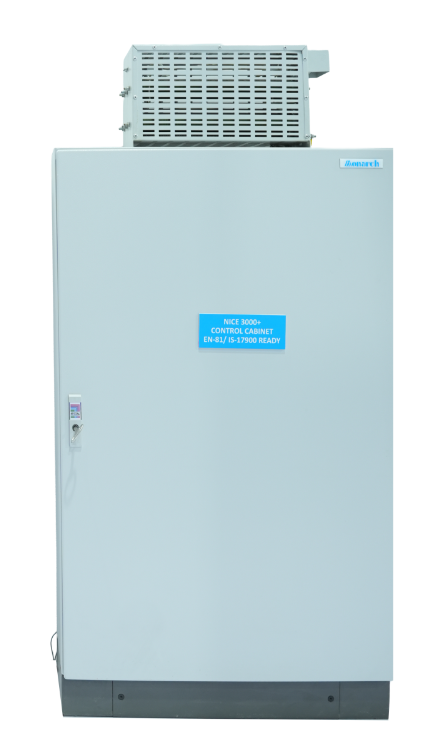
Inovance’s NICE series integrated drives ensure smooth acceleration, precise levelling, and consistent performance across all speed categories. For passenger elevators in a building, the general recommendations are given in the following table, recommended by NBC’2016.
Sl No. | No. of Floors | Speed |
1 | Up to 6 | 0.6 to 1.0 |
2 | 7 – 15 | 1.0 to 1.5 |
3 | 16 – 20 | 1.5 to 1.75 |
4 | 21 – 30 | 1.75 to 2.5 |
5 | 31 – 45 | 3.0 to 4.0 |
6 | 46 – 60 | 4.0 to 6.0 |
7 | Above 60 | 6.0 and above |
4. Drive & Control System Integration
Integrated drive and control systems are essential for performance, reliability, and simplified implementation.
VVVF drives enable smooth acceleration, high levelling accuracy, and energy efficiency
Integrated architecture ensures fail-safe operation, supporting critical safety functions such as UCMP, ACOP, and real-time monitoring of brakes, doors, and safety circuits
Inovance’s integrated solutions combine controller and drive functions into a unified platform, reducing complexity while enhancing coordination and system reliability.
5. Safety & Compliance
Safety remains a core requirement in VT system design. Key considerations include emergency operations, evacuation functionality, advanced fault detection, and compliance with evolving standards such as IS 17900.
Inovance E-package solutions are engineered to meet stringent Indian and international safety standards, ensuring dependable operation. Features such as access-controlled operation (e.g., card-based systems) further enhance security in residential, commercial, and restricted environments.
6. Energy Efficiency & Sustainability
Energy efficiency is a key consideration in modern VT systems, driving both cost savings and environmental sustainability. This is achieved through technologies such as regenerative braking, high-efficiency PMSM motors, advanced VFDs with Active Front End (AFE), and low standby power consumption. Inovance solutions effectively recover braking energy and feed it back into the system, reducing overall power usage while supporting green building initiatives.
7. Installation Environment
Environmental conditions such as temperature, humidity, power quality, and space availability significantly impact system performance and longevity. Inovance designs robust and adaptable VT solutions that ensure reliable operation across diverse and challenging installation environments.
Prerequisites for VT System Selection
1. Building Data & Functional Requirements
A clear understanding of the building is fundamental to VT system design. Key inputs include building type (residential, commercial, hospital), number of floors, total height, floor-to-floor height, population density, and usage patterns. These factors define system configuration and performance expectations.
2. Traffic Analysis & Demand Estimation
A scientific traffic study is essential to avoid under- or over-design. It evaluates peak conditions (up-peak, down-peak, inter-floor) and key metrics such as Handling Capacity (HC), Interval (waiting time), and Round-Trip Time (RTT). These parameters determine: Number of elevators, Capacity (persons/kg), Required speed and performance level.
3. Architectural Planning & Space Allocation
Efficient VT design must align with the building layout to ensure smooth movement and user convenience. Key considerations include: Centralised elevator placement for efficiency, an adequate number and size of shafts, Sufficient lobby space to prevent congestion, Optimal positioning of escalators and travelators
4. Structural Provisions & Mechanical Readiness
Structural integrity is critical for safe and reliable operation. The lift core must withstand static and dynamic loads during operation and emergency conditions. Essential parameters are Shaft dimensions, Pit depth and overhead clearance, Load-bearing capacity and Guide rail fixing provisions
5. Electrical & Power Infrastructure
A robust electrical system is essential for reliable VT performance. This includes an adequately connected load to handle motor starting currents, a dedicated power supply to avoid interference, Proper earthing (double earthing) and surge protection. These ensure equipment protection, system stability, and passenger safety.
6. Safety & Fire Protection Requirements
Vertical Transportation (VT) systems must comply with stringent safety norms to ensure the protection of both passengers and building infrastructure. This includes the provision of fire-rated shafts and landing doors to prevent the spread of smoke and fire, as well as the installation of a dedicated fireman’s lift in high-rise buildings to support emergency response operations. In addition, VT systems are equipped with emergency alarm and communication systems to assist passengers during unforeseen situations. Features such as an Automatic Rescue Device (ARD) enable the safe evacuation of passengers to the nearest floor during power failures, while integration with the building’s fire alarm system ensures automatic elevator recall and coordinated emergency response.
7. Accessibility & Universal Design
Inclusive design ensures accessibility for all users by incorporating features such as barrier-free access with ramps and wide doors, Braille-enabled and tactile interfaces, and audio-visual indicators for floor announcements and direction. It also includes wheelchair-compliant car dimensions, emergency intercoms with visual acknowledgement, and full-height infrared light curtain sensors to enhance door safety.
8. VT System Type & Control Strategy
Early identification of the VT system type and control logic is essential for effective design and performance. This includes selecting the appropriate system type—such as passenger, freight/service, hospital (stretcher) lifts, escalators, or travelators—along with the right control strategy. Depending on the building’s requirements, this may range from simple collective control for low-rise applications to group control for mid- and high-rise buildings, and advanced destination control systems for high-traffic environments.
9. Legal Compliance & Approvals
Compliance with statutory regulations is mandatory. This includes lift inspector approvals and adherence to applicable standards such as NBC and relevant IS codes.
Conclusion
Selecting the right VT system is crucial for building efficiency, passenger experience, and long-term costs. By carefully evaluating key parameters and prerequisites, an optimised solution can be achieved. Inovance addresses these needs with its complete E-package, featuring NICE series integrated controllers and elevator drives such as ME320LN, MD500L, and WISE310, along with AFE regenerative solutions for improved energy efficiency. Supported by high-quality components and intelligent control systems, Inovance delivers reliable, safe, and energy-efficient VT solutions for modern, high-performance buildings.